Why Your Bedroom Needs an Air Purifier More Than Any Other Room

You wouldn't put a fish in a tank without a filter. The water is its whole world. Whatever is in the water get’s absorbed and becomes part of the fish, day after day.
Air works the same way for us. We just don't see it, so we don't think about it.
And there's no room where this matters more than your bedroom.
The room where we spend the most time
Most people picture their living room or kitchen as the heart of the home. But if you add up the hours, it's the bedroom that wins. Somewhere around a third of your entire life is spent there, most of it asleep, breathing slowly and deeply, in one enclosed space, often with the door and windows closed.
The EPA has found that Americans spend about 90 percent of their time indoors. Layer in that a huge share of that indoor time happens in one small room, and the bedroom stops looking like just a place to sleep. It's the room your body depends on most to rest, repair, and recover. That makes the quality of the air in it a bigger deal than most people realize.
What's actually in that air
Two things are worth knowing, because both are more common than people assume.
Mold and moisture.Research compiled by NIOSH shows roughly 47 percent of U.S. homes showing signs of dampness or mold. That's nearly one in two homes. Moisture problems don't always show up as a stain on the ceiling. Sometimes it's a musty smell, a damp closet, or nothing you can detect at all without testing. A 2007 study often cited by the EPA links about 21 percent of U.S. asthma cases to mold exposure in homes.
VOCs from the building itself. VOCs are the compounds that off-gas from paint, flooring, furniture, mattresses, and cleaning products. The EPA's own research has found that common organic pollutants are routinely 2 to 5 times higher indoors than outdoors, no matter whether the home is in the middle of a city or out in the country. Your bedroom, full of textiles, furniture, and finishes, is often one of the more concentrated rooms for this.
Neither of these requires an old house or an obvious problem. Newer homes, tightly sealed for energy efficiency, can trap this stuff in just as easily.
What an air purifier can, and can't, do
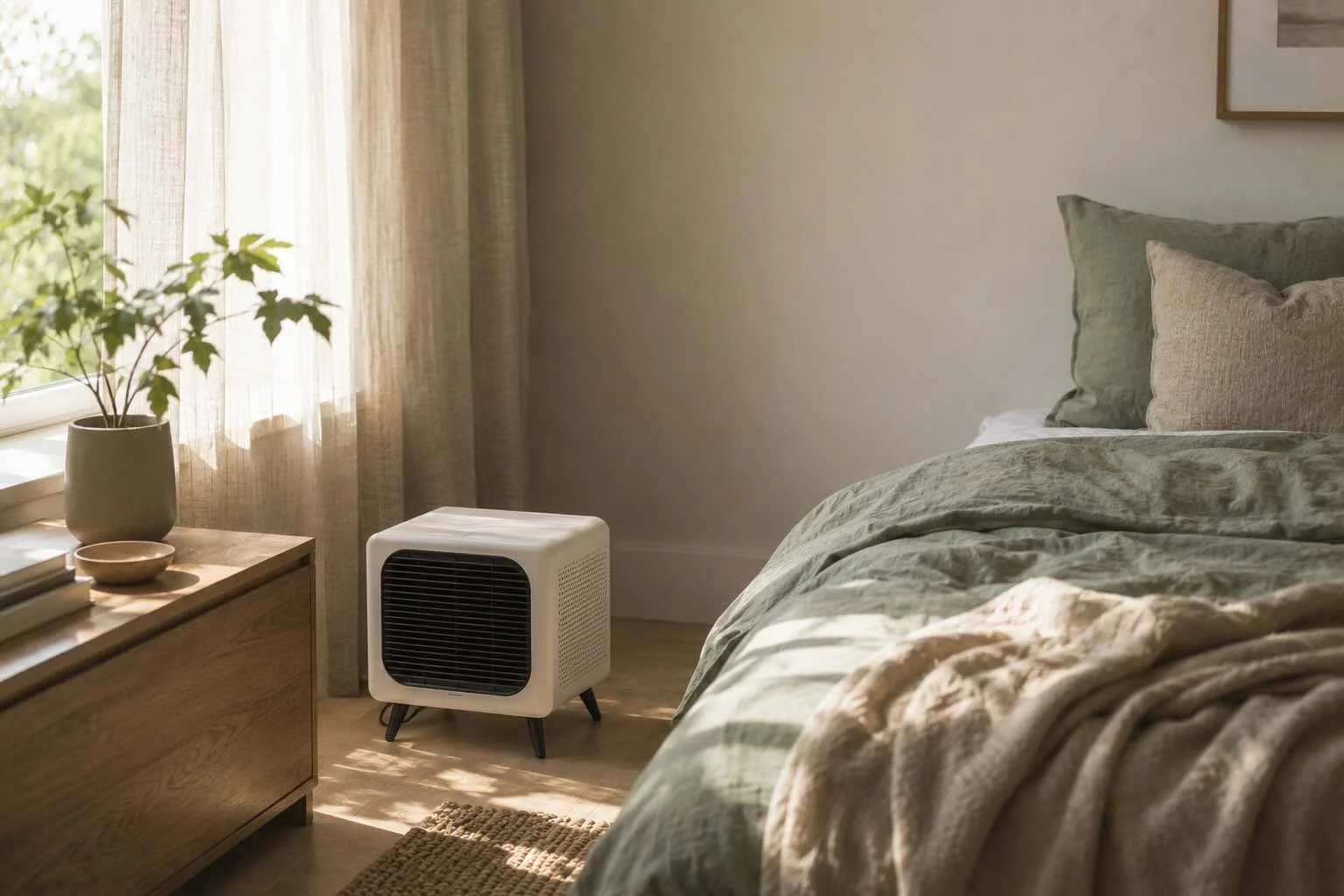
A good air purifier is one of the simplest ways to reduce what you're breathing in overnight. It won't fix a moisture problem at its source, and it isn't a substitute for finding and correcting the cause if one exists. But it can meaningfully cut down what's floating in the air while you sleep: dust, allergens, some VOCs (with the right filter), and airborne particles from mold that's present but not yet visible.
Think of it as damage control for the room you can least afford to have compromised. If your air is already clean, a purifier keeps it that way. If something's off, a purifier buys you cleaner breathing air while you sort out the real cause.
What to look for
True HEPA filtration, not just "HEPA-type" or "HEPA-like," which are marketing terms without the same standard behind them
A carbon or VOC filter stage, if off-gassing or chemical odors are a concern
A low noise rating, ideally in the 20-30 decibel range on its lowest setting, since a loud unit is one you'll turn off at night
The right size for the room, sized generously rather than exactly, so it can run quietly on a low setting and still keep up
The bigger picture
An air purifier is a good habit. It is not a diagnosis, and it is not a fix for a hidden moisture problem. If you've got a purifier running and still notice musty smells, unexplained symptoms, or a home that just doesn't feel right to breathe in, that's usually a sign to look closer at the source, not just filter around it.
Your bedroom is where your body does its most important work of the day: resting and recovering. It deserves air you don't have to think twice about.
